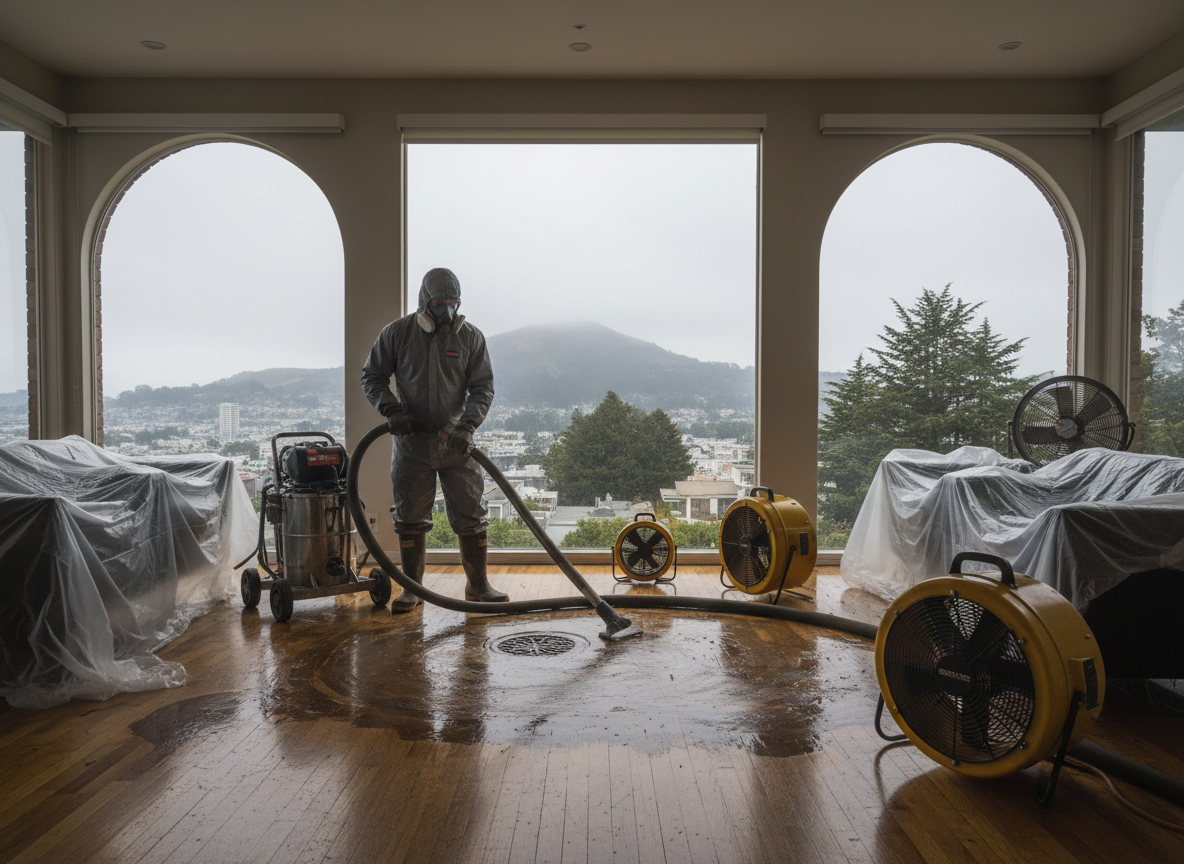
Twin Peaks sits at elevation in San Bernardino County where winter freezes routinely split copper lines in 1960s-1980s cabins. When a line bursts under a crawl space or behind knotty-pine walls, water travels fast along the slope and pools against the foundation before homeowners notice. Emergency water removal here means getting submersible pumps and air movers on site before the water saturates the particleboard subfloors common in these older builds.
Summer thunderstorms can dump heavy rain on already saturated ground, sending runoff under raised decks and into basements along Highway 189. We stage equipment at our Twin Peaks shop at 26100 CA-189 so we can reach properties in Crestline or Lake Arrowhead within the hour. The terrain forces us to carry extra hose lengths and portable generators because many driveways become impassable once water crosses the gravel.
We pull baseboards and drill weep holes in wet drywall rather than tearing out entire rooms, then use moisture meters to confirm the studs have dried below 15 percent before we close the walls. Skipping this step in the cold winters here lets hidden moisture freeze again and reopen the same leak path the following season.
Because many Twin Peaks homes still have galvanized supply lines, a single pinhole leak can release several hundred gallons overnight. Our first action is always to locate and shut the main valve, then map the water path through the layered additions these mountain cabins have accumulated over decades.
Technician insight
In Twin Peaks the thing that catches most people out with emergency water removal is how fast snow-melt water travels under the raised floors of 1970s cabins once it hits the slope; homeowners shut off the water but leave the wet insulation sitting against the rim joist and wonder why the smell returns every winter.
Burst Line Under Deck
A main supply line split during a cold snap and water ran under the deck of a home off Kuffel Canyon Road. We pumped out the standing water, opened the rim joist to pull saturated batts, and ran drying equipment for four days until moisture readings stabilized. The owners avoided a full floor replacement by catching it before the particleboard delaminated.
How it works
- 1
Arrival and Safety Shutoff
We reach the property, shut off the main water supply, and assess electrical hazards before any extraction begins.
- 2
Standing Water Extraction
Submersible pumps and wet vacuums remove bulk water from floors, crawl spaces, and low-lying areas typical of sloped Twin Peaks lots.
- 3
Moisture Mapping and Wall Access
Infrared cameras and meters locate hidden moisture behind paneling and under subfloors; we create controlled openings to prevent mold in the cold, damp winters.
- 4
Drying and Monitoring
Air movers and dehumidifiers run until readings drop to acceptable levels, with daily checks to adjust equipment as mountain humidity swings.
Pricing
Cost depends on water volume, access difficulty on steep driveways, and whether hidden moisture has reached subfloors or insulation.